Believe in the Story: Narrative and the Religious Instinct in the MaddAddam Trilogy

This past Thursday, Ocean County College was abuzz with all things Atwood. The one, the only Margaret Atwood was speaking as part of the Blauvelt Speaker Series, and my colleague Jayanti Tamm organized a day of scholarly presentations titled “Pen, Power, and Prophecy: A Symposium on the Literary Legacy of Margaret Atwood.

I was part of the first panel on speculative fiction along with Dr. Jen Dellner, Professor of English, OCC,
Dr. Christine Kephart, Assistant Professor of Writing, Rutgers University, School of Social Work, and Dr. Pamela J. Rader, Professor of English & Director for the Center for Teaching & Learning, Georgian Court University.

The presentations focused on the role of folktales, naming, and, in an apt nod to current debates, higher education.

Below you’ll find my presentation, which examined the role of stories in the creation of religion. It’s a topic that’s been rattling around in my brain for years, after gorging myself on a pile of dystopian fiction including the MaddAddam trilogy and Russell Hoban’s Riddley Walker. Both suggest that, like a phoenix, religion rises from the ashes of a collapsed society.

It’s short (10 minute limits), but the enforced brevity helped sharpen my points.


Believe in the Story: Narrative and the Religious Instinct in the MaddAddam Trilogy 

Given the nature of this symposium, I think a summary is a good place to start. The setting: mid to late 21st century America.  Climate change and species depredation continues apace: coastlines have dissolved — New New York is in New Jersey.  The 1%, educated and pampered, live upper-middle class in compounds owned by pharmaceutical companies. The 99% eke out a precarious existence in the pleeblands.  

Elections? Rigged.  Press? Gagged.  Crime? Who cares (unless it effects the 5% — or cuts into profits). Greed and a survival of the fittest ethos reign.  The genetic code is cracked: all diseases can be cured.  So what’s a poor drug company to do?  Invent new ones.  The novels revolve around Glenn (aka Crake), a wunderkind of the pharma compounds and his partner Oyrex.  Disgusted with the state of the world, he 1) creates a new human species (Crakers) and 2) a drug to kill all other humans.  After the drug is released, the Crakers and a few other humans survive.  This and a lot more, is recounted over the 1,200+ pages of the novels.  The first two, Oyrx and Crake and Year of the Flood cover the decades before the apocalypse; Maddaddam deals with its aftermath.   

As my title suggests, I’m interested in how the novels link storytelling with religion.  Atwood herself makes this connection explicit in her essay, “Burning Bush” when she writes that “science fiction is where theologically linked phenomena and reasonable facsimiles of them went after Paradise Lost” (“Burning” 64).  The MaddAddam trilogy, cataloged as science fiction, offers just such a “reasonable facsimile,” showing that in the fallen world of the novel, when all theologies have been erased by an apocalypse, the Crakers breathe life into religion with their embrace of stories.  Through the genres, ritual, and repetition of their narratives, Atwood reveals how stories nurture the religious instinct.  

The connection between religion and narrative is made clear in the genre of the stories told to the Crakers: creation myths and parables.  This is underscored early in the novel in a recollection of Jimmy’s, Glenn’s friend, survivor of the epidemic, protector of the Crackers, and their first prophet. Haunted by the “chaos” unleashed by his friend, he spends much of his time lost in reverie. In one daydream he recalls a few lines of New Age claptrap: “Each one of us must tread the path laid out before him, or her [. . . ] and each path is unique. It is not the nature of the path itself that should concern the seeker, but the grace and strength and patience with which each and every one of us follows the sometimes challenging …” (28). He shuts off this homiletic memory with a curt “Stuff it” (28).  Note that there is no story here, only a pale exhortation; tedious doctrine instead of spiritual narrative.  

Contrast that pablum with the creation story Jimmy, in the guise “the Snowman,” tells the Crakers: “the Children of Oryx hatched out of an egg, a giant egg laid by Oryx herself. Actually she laid two eggs: one full of animals and birds and fish, and the other one full of words. But the egg full of words hatched first, and the Children of Crake had already been created by then, and they’d eaten up all the words because they were hungry, and so there were no words left over when the second egg hatched out. And that is why the animals can’t talk” (110 OC).  In this short account, two elements of religion are fulfilled – the origin story, and an explanation of natural phenomena.  The Crakers come from an egg (which mirrors the biological process they see in the wild) and a rationale for why they can speak but animals can’t.  Instead of telling them, as in the lines Jimmy recalled, the myth is crafted into a story.  The significance of narratives is made clear at the end of the novel.  Blackbeard, the first Craker prophet, finds his belief in his religion tested after finding the bones of Crake and Oyrx.  What pulls him back into the fold? The power of the legend.  He tells his congregants that “Oryx and Crake had different forms now [ . . . . ] the way we know from our stories” (434 or 35MA).  To borrow a phrase, when the legend becomes (accepted) fact, print the legend.  

The ritual surrounding storytelling amplifies its spiritual power. The Crakers insist that Jimmy (or as he is known to them, Snowman) follow the same steps before telling the story: they must first ask him for a story; he must put on a Red Sox baseball cap, listen to a broken wristwatch for the “words of Crake,” and then eat an offering from the Crakers.  Their method of addressing their storyteller is particularly relevant here. The Crakers, a deceptively simple people, resort to the vocative case when addressing him “Oh Snowman.” While common in Latin rhetoric, the vocative case is seldom used in English. This more formal grammar elevates the stories, shifting them from tales to gospel. And shift the narrators from yarn spinners to Prophets. A transubstantial rhetoric, it lifts the stories into the spiritual realm.  

Similarly, the roasted fish the Crakers bring to the prophets at the beginning of the service, invented by Jimmy to gain a protein source, by the end of the story becomes an integral part of the ritual.  After Jimmy and Toby, the first two prophets, have died, the Crakers themselves assume the liturgy.  Blackbeard, tellingly, the first Cracker who learned to read and write, becomes the priest, presiding over the ceremony.  Mirroring the sacrificial cannibalism of the Eucharist, Blackbeard “eats” the fish – even though as a Craker he is biologically constructed to reject flesh.  Following the example of previous prophets, he too dons the Red Sox hat and “listens” to the watch – though he now knows that no voice comes through it.   

Finally, the Craker’s desire to hear the same stories again and again link narratives to the divine. When first mentioned, it’s clear they have been taking place for some time. Jimmy asks “’What part would you like to hear tonight?’ [ . . .] ‘In the beginning,’ prompts a voice.”  Jimmy begins “In the beginning, there was chaos,” (an echo of Judeo-Chrisian creation myths) “’Show us chaos, please, oh Snowman!’”  Here Atwood accentuates the cyclical nature of the stories, writing that “Snowman has known this request would be made” (118). The “known” carries the weight of repetition; it underscores that, just as in a more formal liturgy, the congregation expect stories to follow a particular order. 

At the end of the trilogy, the liturgy that has been transmitted orally, is written, codified, and then amended by Blackbeard, the Craker Prophet.  He tells his people that it contains “the Words of Crake, and the Words of Oryx as well, and of how together they made us, and made also this safe and beautiful World for us to live in. And in the Book too are the Words of Zeb, and of his brother, Adam; and the Words of Zeb Ate A Bear” (466MA).  The repetition of “Words” cements the role of narratives in the faith of the Crakers.  It’s a faith rooted in words and the stories they create.  

I’d like to end with why? Why do the Crakers – and so many of their human kin – need religion. This is answered, in part, by a character in the novel who says: “People need [ . . . ]stories [. . . ] because however dark, a darkness with voices in it is better than a silent void” (188 MA). But that doesn’t transform the novels into a religious tract: the misdeeds of the Church of PetrOleum in this series and the depiction of religion in Handmaid’s Tale offer a clear-eyed vision of how blind faith can curdle into authoritarianism. Still Atwood herself argues that “most cultures” believe in a god or gods.  She writes in an essay that “Maybe such a belief is an evolved adaptation. Maybe your survival chances are better if you think there is a powerful being on your side who has a master plan” (“Burning”55).  She adds that because “the scientific mythos is not very comforting [. . . . ] human beings prefer stories” (“Burning” 55).  They are a fiction that sustains the larger fictions we use to keep the darkness at bay.  
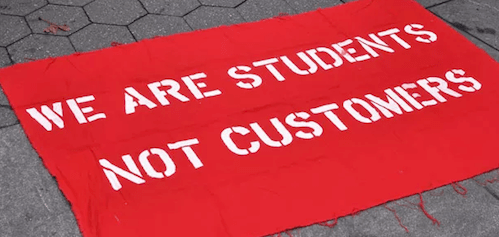
Educational Transactions?

Source: https://www.savethestudent.org/uploads/students-not-customers-min.png

At a recent Spring colloquium, our president noted that faculty needed to move from a transactional view of teaching (an emphasis on grades) to a more holistic view (an emphasis on student learning). I was both confused and pleased. Confused because over the last several years our college, like so many others, has doubled down on the idea of college as a transaction: college as job training. Students are customers. Credentialing. Etc.

I was pleased because this embrace of teaching for intellectual growth has guided my instruction from the start. To make this clear to students, about 25 years ago, following the lead of my esteemed colleague, Mary Ellen Byrne, I began including an introduction for all of my classes. It varies from course to course, but always emphasizes what students will learn instead of how to game the system for grades.

I thought others might be interested in the pedagogical philosophy behind a Community College English course, so below you will find the latest iteration of my introduction for English II, a course which combines an introduction to literature with composition. And yes, the “II” denotes it as the second and final course in our college’s two semester composition sequence. The “site” mentioned in the opening paragraph refers to the course site the introduction is posted in.


For the next fifteen weeks you’ll be reading and responding in writing to a wide range of literature.  To ease you into the course, I’ve included on the site materials that should assist your understanding of the readings, clarify the writing assignments, and lend a helping hand (or a shoulder to cry on).

What We’ll Be Doing Each Week

Reading, discussing, and then writing about literature. 

Let’s break that down a bit. 

The class moves on two tracks: 1) reading and interpretation; 2) writing.

A specific task is due for each class: in the first few weeks, these tasks involve closely reading and annotating and thinking about what happened and why in a short story.  The work here consists of developing your ability to grasp the nuances of reading: specifically, how words and their connotations create/shape meaning, alter perspectives, and help us gain insight into human psychology and culture. This entails rereading the stories: once to find out “what?” as in what happens in the story; the next to understand “why?” as in why the characters acted the way they did.

We’ll then shift to writing, where your tasks will brainstorming, drafting, revising, back to brainstorming and drafting, then revision, revision and proofreading, proofreading, proofreading (the repetition is DEFINITELY intentional) that lead to clear and engaging paragraphs and essays. 

This is all in the service of developing your thinking, defined by the cognitive scientist Daniel T. Willingham as “solving problems, reasoning, reading something complex, or doing any mental work that requires some effort.”

Reading

Although most people think only of books when they hear “reading,” the activity takes many different forms. You read a movie, making connections between the girl in the red dress and the man with the revolver who appears in the car chase scene; you read the road from behind the wheel of your car, carefully avoiding skunks, pieces of wooden pallets, and orange cones; you read a teacher’s demeanor on the first day of class wondering, “Is she a hard grader?” “Can I catch up on my sleep in this class?” All of these kinds of reading involve a studied, concentrated look at a particular event, landscape, or person in an effort to extract some kind of meaning.  I bring up these different forms of readings only to show that even if you aren’t used to reading books, you’re used to reading.  For this course, you’ll use these same skills and apply them to the written word.

Now of course you’re thinking “Like, I already know how to read – thanks.”  But the kind of close, analytical reading required to fully appreciate literature (and to fully appreciate any written work) is a skill that’s faded in our media saturated age.  Consider your computer.  Years ago we had to memorize a few text-based DOS commands such as COPY, MOVE, etc to make our computers work.  Now? Move the mouse and point to a  . . . picture.  And think of the internet.  What draws you to a web page – the eye-candy graphics or the rich and in-depth text which stimulates deep thought?  I thought so. . . . In fact, reading any text over a screen length online is a cumbersome chore entailing much eye-squinting and scrolling down of screens.

This course is designed to reacquaint you with the rigors and rewards of reading.  First, the rigors.  Reading closely means paying attention to not only the plot – or what happens in a story – it means paying even more attention to why it happened.  This digging deeper, paying attention not just to the surface of the story but the implications behind a word or phrase (Why an A&P? Why a rose? Why a cow? Why a cathedral and not a castle?) is what reading well is all about.

And this is where the rewards come in. As you learn to attune your eye/ear to the more subtle gradations of thought and feeling in literature, you’re learning to look more closely at the world around you.  The kind of reading that this class fosters will be used both as you interpret a marketing report in your career as Assistant VP to the VP for Marketing at Widget© Inc., and as you see through the spin of a political advertisement that presents a candidate whose father and grandfather were both members of the senate (and whose father was a president) yet who proclaims that he’s “not from Warshington.” 

As the two examples above suggest, we’re still awash in a sea of words, and the skills you’ll learn in this class – paying attention to the connotations of words, an awareness of how irony and point of view can affect meaning, understanding how figurative language can express complex and abstract ideas – will give you that edge you need to succeed in your careers – and be the life of the party.  More importantly, learning to read analytically gives shape to that endeavor we call life.  It clarifies the world around us, providing the language (and thus the thinking) we need to move from grunting, mewling automatons ruled by the latest marketing gimmick beamed to us via satellite from WeOwnTheWorld Inc., to thoughtful, skeptical, reasoning – and above all alive and kicking individuals. 

That “kick” is important because modern life, with its consumerist, let’s-satisfy-my-basic-urges-first attitude, results in complacency and apathy.  Reading allows you to get to the essentials of life, to cut through the mental static of the McJobs you suffer through to pay your car note, the fleeting satisfaction of the great shoes you bought at Nine West, and the empty sensations of screaming at the villain of the month on your phone, be it the behemoth with makeup on WWF, or the latest ruler of a small nation that dares to disagree with us.  Reading allows us to, as the novelist and critic Jay Pirani suggests, swing “a lantern ahead of us in the fog of our lives” (26 I’ll supply the lantern – great literature – you bring the matches (more prosaically known as your brain and your interest).

Recent research suggests that reading literary fiction develops your Theory of Mind, defined as “The capacity to identify and understand others’ subjective states [ . . . .which] allows successful navigation of complex social relationships and helps to support the empathic responses that maintain them” (Comer Kidd and Castano).  Because Theory of Mind is a central part of navigating successfully through life, Parini’s metaphor of a lantern is particularly apt. Literature develops this “capacity” because, as the psychologists David Comer Kidd and Emanuele Castano argue, “Just as in real life, the worlds of literary fiction are replete with complicated individuals whose inner lives are rarely easily discerned but warrant exploration.”

They contrast “literary fiction” — works that challenge readers . . . you know, stuff you read in college — are what’s needed to trigger intellectual growth.  “Popular fiction” — beach and bathroom reading (not that there’s anything wrong with that . . .) — “tends to portray the world and characters as internally consistent and predictable” and is thus less likely to challenge our perceptions (Comer Kidd and Castano).

“Complicated individuals” . . . who need “explanation” . . . yep: sounds like an English course. 

Moving from emotional to analytic intelligence, researchers Travis Proulx and Steven J. Heine similarly found that reading literary fiction (which deeply challenge our preconceived views of the world) led to improved scores on pattern recognition tests.  This ability to discern patterns in our daily lives is central to the rise of homo sapiens: our early ancestors used this skill to recognize which plants and animals they could eat – and which to avoid.  It later provided the basis of written language itself: making marks on a clay tablet was much better than trying to remember how many goats a worker was paid for her monthly work. Today, this skill allows us to see through the false promises of advertising and demagogues and make thoughtful decisions on which car to buy . . . and who to vote for. 

Teaching and Reading Literature

My approach to teaching literature is an extension of my approach to reading.  First, I read and enjoy the work, willingly suspending disbelief and entering the world created by the author. Later, and on a more analytical basis, I work at a basic understanding of the mechanics – plot, character, point of view, theme, symbolism – but what I always come back to is the vision of life offered by the text. Just what are the prominent features of this fictive world, and how does it comment on or reflect the human condition? Thus, you’ll find me continually turning to examples from everyday life – in other words, from history, psychology, anthropology, art, sociology, etc. – to explain the beauty, relevance, or meaning of a particular text.

On a different note, we – students of literature (and for the rest of the semester, you’re included in this definition) – look at these works closely because any text worth reading is worth the same intellectual effort that goes into any critical examination of a topic. Looking for connections and meanings in a given work of literature is similar to figuring out the causes of the Civil War – or the effects of El Niño on world climate.  By that I mean it is an intellectual exercise designed to get you to closely examine one particular aspect of human behavior or nature, and through it derive some solace, moral, or understanding of the vast and complex web of relations we call life.  Thus the kind of thoughtful, reflective reading this course demands is meant to reshape the way you perceive the world around you, allowing you to glean new insights into the tensions between the expectations of a family and the pull of video games, the emotional detachment of a worker in late twentieth century America, and the emotional burdens of a cat call.

To foster this kind of attentive reading, you should read each assignment at least twice (four times to infinity for poetry): if you’re like me, the first time you read to see what happens and the second time around, you read to see why it happened.  Remember, as well, to read with a pen or pencil in hand and mark up your book copiously.  Jot down questions to yourself, note where odd lines of dialogue or description occur, argue with the author, or “nod” your head in agreement.  While simply highlighting the text may work with a biology textbook, in literature what you say back to the text is just as important as what the writer says.  This “talking back” to the text is a sure sign that you’re reading attentively – which is the way you should be reading for this course.

Writing

Moving from reading to writing (this course is, after all, the second half of OCC’s writing requirement), consider these general remarks on essays. In formal writing, you have to organize your thoughts and communicate them clearly to the reader. This means that instead of just dumping everything you know about a story or poem or play into your essay or body paragraph and saying “there – that oughta’ do it,” you have to form your thoughts into an organized piece of writing.  Granted, in the early stage of writing, you do need to let it all out – put all of your thoughts down on paper, whether in lists, diagrams, or short paragraphs.  But as you begin crafting your essay, you need to look over all of your brilliant insights and say “I like the quote about the lady as a cash register watcher, but it doesn’t fit in my argument” – and then take it out..

As you build an essay, keep in mind two common maladies in writing about literature: quote bloat and development deficit.  To cure quote bloat, remember that it’s not the number or length of quotes that makes a good essay – it’s how well you explain them.  Two short quotes in a paragraph, explained in detail, are better than four long ones that are merely glossed over. 

The remedy for development deficit is to get the reader to “see” and “read” a text the way you do.  Without letting them get inside your head – in other words, writing your thinking down – the reader will be blind: and you’re not writing in Braille.  While you may think “any blockhead can see what I mean by this quote,” you need to realize that I am the mother of all blockheads.  Your job is to show the reader that you know how a particular quote – which is merely a string of words – supports your argument.  Even something as patently obvious as the color red suggesting anger needs to be clarified.  Instead of anger, red could mean love or embarrassment.   So you must explain how, in general, red is associated with anger, or love, or embarrassment, whichever is germane to the argument.  For instance, when reading essays, for every quote I ask “Now how does this support the argument?” or “Hmmm, why this quote?  What’s its connection to the rest of the paragraph?”  The key is to anticipate and answer questions an ignorant reader may have with your thinking on a particular literary work.  And since I cannot read your mind, I come to your essay as an ignorant reader: it’s your job to make it as easy as possible for me to follow your thinking.

And there is no getting around it: getting through to us ignorant readers takes time. Willingham makes the following observation about the perception of time needed to excel in college and the actual time it takes to excel: “At the college level, my low-performing students frequently protest their low grades by telling me, ‘But I studied for three or four hours for this test!’ I know that the high-scoring students study about twenty hours.”

Twenty hours is a lot.  But when strung out over several weeks in half hour increments and includes class time, it’s manageable. To make this easier we’ll be working together on your out-of-class essays, and while I encourage you to let others read and offer suggestions on your work, I strongly suggest you use myself, a classmate, or a tutor from the Tutoring Center as your primary readers/reviewers.  Save all drafts – especially those with questions from other readers.

One last thing: be prepared to enjoy the class. We’ll be reading some great stories and poems and having engaging conversations about them.

See you in class.

Works Cited

Kidd, David Comer, and Emanuele Castano. “Reading Literary Fiction Improves Theory of Mind.” Science, vol. 342, no. 6156, Oct. 2013, pp. 377–80. EBSCOhost doi:10.1126/science.1239918, accessed 3 August 2023.

Parini, Jay. “The Bog Poet.” Nation, vol. 268, no. 1, Jan. 1999, 1399392, pp. 25–28. EBSCOhost, accessed 1 January 2025.  

Proulx, Travis, and Steven J. Heine. “Connections From Kafka: Exposure to Meaning Threats Improves Implicit Learning of an Artificial Grammar.” Psychological Science, vol. 20, no. 9, Sept. 2009, pp. 1125–31. EBSCOhost, doi:10.1111/j.1467-9280.2009.02414.x, accessed 3 August 2023.

Willingham, Daniel T. Why Don’t Students like School?: A Cognitive Scientist Answers Questions about How the Mind Works and What It Means for Your Classroom. Jossey-Bass, 2009.

Here I Stand

As a number of articles have made clear, AI has flooded college campuses.

As a longtime writing professor, I believe it serves no place in composition classes.

Other courses? To those professors saying “it’s like any other tool,” I ask them to consider the following. What’s the difference between shopping yourself to select the best ingredients, doing your own slicing and dicing, and then sweating over burners and an oven until the meal is ready to be plated with a garnish of your own design vs. placing an order through DoorDash, putting the food prepared by professionals on the table and pronouncing yourself a chef?

The difference illustrates the problem with ChatGPT. In both cases, you’re “serving a meal,” but in the former, you demonstrate cooking skills. In the latter, you demonstrate button pressing skills — which isn’t exactly higher order thinking.

Which brings me to Essay 2 in my online Composition course.

In my F2F sections, following the lead of others, I’ve switched to writing rough drafts in class to get a baseline snapshot of the student’s work.

Online it’s a crap shoot.

For Essay 1, assigned early in the semester before the work load hit, students mainly avoided AI. Essay 2 was another story. Of the 14 students still submitting work, 6 were flagged or admitted to using AI. But they didn’t use it to “write” their essay. I know this because of responses to my query: “Before grading this, I need to hear from you. This essay was flagged with x% AI. Write me an email explaining how you used AI when writing this essay.” 

I learned that students used AI to “plan,” “outline,” or “proofread” their work. Most asserted that the essay was still their “own.”

Instead of my usual Friday morning grading, I wrote the following message and posted it to the course site.

In a way, I was grateful because it forced me to collect the wool that’s been gathering in my head regarding AI and frame it for a student audience.

Is it too cute to note that this was written without AI?

I’ve had a learning experience as I began reading your Essay 2 submissions.

I found that some students believe that using AI in parts of their essay — outlining; proofreading; etc. – is okay.

Since this assumption is incorrect, below you’ll find explanations to clarify why the course syllabus states you cannot use AI; they should help guide you toward success in the course.

Let’s get the basics out of the way.  The syllabus has a brief discussion of AI:  

“To bulk up your cognitive and writing strength, this course requires that work submitted by students – including brainstorming, planning, drafting, revision, and final drafts – will be generated by you, working individually or in groups as directed by class instructions.”

It also explicitly notes that “If you choose to use AI to complete an assignment, the grade for that assignment will be a zero.”

Researchers at MIT Media Lab capture the deep learning that students gain in a composition course.  They note that “Essay writing places significant demands on working memory, requiring simultaneous management of multiple cognitive processes. A person writing an essay must juggle both macro-level tasks (organizing ideas, structuring arguments), and micro-level tasks (word choice, grammar, syntax)” (Kosmyna 10-11).

Using AI in any part of the writing process means that instead of the individual “cognitive processes” noted above, I’m reading the work of a machine. If you use AI software to plan your essay, you’re missing an essential skill that applies to any intellectual endeavor: how to find patterns in disparate information and organize that information to, in the case of this course, make an argument. 

If you use AI software such as Grammarly or other programs to proofread, you’re missing the development of a writing voice/style that moves beyond the bland uniformity of a machine.  And again, since writing is a package deal involving many different skills, in both cases, instead of your own work, I’m evaluating the work of a machine.  The problem is that I’m supposed to be evaluating the work of your mind.
 
How does a machine take over your mind? In an experiment involving students writing papers with and without ChatGPT, researchers concluded that those using their “Brain-only,” were, to put it in plain words, smarter.  To put it in the words of MIT scientists: “the Brain-only group correlated with stronger memory, greater semantic accuracy, and firmer ownership of written work. Brain-only group, though under greater cognitive load, demonstrated deeper learning outcomes and stronger identity with their output” (Kosmyna  138).

“Deeper learning outcomes”?  That is what this course wants you to gain.

I’ve included this detailed explanation because you deserve to know the rationales behind the decisions colleges and professors make when planning a course.

Given this explanation, you can understand why I’m reminding everyone about the directive in the syllabus: do not use AI for any part of this course.  This includes Grammarly, ChatGPT, or other programs that plan, organize, research, revise, or proofread an essay. If you have been using AI, in any of its many forms in any part of the writing process, it’s time to stop and work on developing your own skills so you can leave this course with a “stronger memory, greater semantic accuracy, and firmer ownership of written work.”  In other words, to leave the course with the skills that will make you a better writer.

And congratulations if you caught the allusion to Martin Luther in the title and image. Luther, at the Diet of Worms, stood by his beliefs and said “Here I stand,” in the process both winning (Protestantism) and losing (Catholicism and its corruptions remain: though it’s not like Luther’s heirs are models of propriety).

He too railed against perceived knowledge, and (at least partly) prevailed.

I stand with the Brains. To borrow the words of Thoreau from his “Resistance to Civil Government,” our courses should “be a counter-friction to stop machine.”

Let the friction begin.

Addendum

A few days after posting the message to students included above, I received the following email from a student.

Your announcement regarding the use of A.I. has really opened my eyes. There is beauty in the struggle and for some reason, your snippet about MIT’s analysis of composition courses is what made me finally see it. Lastly, Please accept my new version of Essay 2, completely free of A.I., and I look forward to working in perfecting the craft of composing in the coming essays.

My first thought was “Wow, the student really got it!”

My second thought was “did he use AI to write this reply?” Such is the erosion of trust wrought by ChapGPT.

Curious about your own thoughts and the methods you’ve used to address AI in writing.

Reply below.

From Blog Post to Academic Journal

This month, the Nanzan Review of American Studies published my article “Twenty-First Century Hucksters: Huckleberry Finn and Trumpism.”

The article started in 2017 as a blog post on this site. Because most journals explicitly prohibit previous publication, after revising and sending it out for review, I deleted it.

Back in all its illustrated glory below, the post shows the differences in tone and voice between blogging and scholarship. According to the reviewers, I was only half successful in navigating these differences. Too often, they were split, either celebrating my work (“Never in the course of my career have I been sent an article manuscript that has impressed me as much as [this]”) or dismissing it (“Reject“).

I was especially surprised at the factual errors in some reviews. In one case a reviewer took me to task for omitting relevant sources . . . when the sources I supposedly didn’t include (and a short discussion of their connection to my argument) were in footnote 3. Perhaps the more reflective, speculative tone, or the overall approach — literary criticism as sociopolitical commentary — didn’t resonate with the readers. And perhaps the article just wasn’t/isn’t that good.

I think the main problem lay in its bloggy roots. My goal was to keep the energy and engagement of online writing, but shift to a more academic tone. It took a while for the gears to fall into place, but the road to Nanzan can be charted by these different (1 more journalistic — not yet academic) iterations (2 full on academic) of the same article (3 not sure if I sent this out, but like the intro). This was my favorite draft (and the one the reviewer above loved), but agreed with a later comment that it takes a while to get to the point. These all led to the final, published, version. Together with the 20+ other drafts that remain (mercifully) on my computer, they act as stamps on a time card, charting out the days and hours behind the “final” draft.

They also remind me of a conversation back in the early 90s when I was in graduate school. In the elevator of the Park Avenue law firm that financed my final years of study, a fellow secretary, knowing that I only worked part time, asked what I did when I wasn’t at the office.

“I’m usually in the library doing research on my dissertation. It’s on Charles Dickens in nineteenth-century America.”1

Beat.

“How much do you get paid for doing that?”

Cue wah wah wah.

And now we go back to where it all started: the original post.

Think of it as the Ur draft, now reconstructed.


A 21st Century Huckster

One of the meta-ironies of the late, lamented Colbert Report was that some conservatives had difficulty perceiving its, well, irony.  In other words, they thought the right wing bloviator Stephen Colbert was an O’Reilly rip off instead of an O’Reilly satire.

This left me wondering.  What about earlier satirists?  Did they also experience meta-ironies? 

What, for instance, were Southern readers thinking in 1884 when they looked at an ad for Mark Twain’s forthcoming The Adventures of Huckleberry Finn, and saw, in large type, a promise that it would be a “MINE OF HUMOR” and, as an “amusing book . . . . A CURE FOR MELANCHOLY”?

I’m betting laughs.

So what was going through their minds when, in chapter 16, they read “Here was this nigger, which I had as good as helped to run away, coming right out flat-footed and saying he would steal his children—children that belonged to a man I didn’t even know; a man that hadn’t ever done me no harm.”

Those still harboring racist sympathies – in other words, most Southerners – yet who were capable of empathy would squirm a bit.  It’s one thing to live with the memory that buying and selling children was as natural as breathing a mere sixteen years earlier; it’s another thing to see it in black and white.  This early chapter primes readers for the moral journey of Huck’s gradual – though ultimately limited –realization of Jim’s humanity, a journey completed under the protective cloak of satire.2

In their review the venerable Springfield Republican recognized the “bitter vein of satire” in his work, but bemoaned its “degenera[cy] into a gross trifling with every fine feeling.”  In other words, they blamed the messenger not for the message but for how he said it

Twain’s satire carries through to the much maligned final chapters where it seems that many modern critics (starting with Leo Marx3) miss the “bitter” satire of Jim’s prolonged enslavement – and endangerment – at the hands of Huck and Tom.  To me, the final third of the novel is a metacommentary on the life of blacks in the Jim Crow South: free, but still imprisoned by people like Tom, who could not separate fact (blacks are human) from fiction (blacks are sub-human and deserving of second class status – separate and not equal), a fiction soon to be enshrined, via Plessy v. Ferguson, in legal doctrine.  In 1896, when the Supreme Court legalized segregation, the fictional treatment of Jim became the reality of blacks living in America.

The end of the novel captures the zeitgeist of a nation where a creeping tide of racial violence led Twain to write – but never publish – “The United States of Lyncherdom.” 

This 1901 essay sheds light on Huck’s complicity in Jim’s treatment – and our own conflicted times.  Twain argues that most people, like Huck, are intrinsically moral, but lack the courage of their convictions . . . and they’re always looking for an excuse to pile on the hate. 

Why does it [the crowd at lynchings] lift no hand or voice in protest? Only because it would be unpopular to do it, I think; each man is afraid of his neighbor’s disapproval–a thing which, to the general run of the race, is more dreaded than wounds and death. When there is to be a lynching the people hitch up and come miles to see it, bringing their wives and children. Really to see it? No–they come only because they are afraid to stay at home, lest it be noticed and offensively commented upon.

Thus when Huck is beached in Arkansas and finds out Jim is at the Phelps’ place, his first thought is to write Miss Watson and let her know where Jim is.  What stops him? As Twain notes above, it’s “his neighbor’s disapproval.”  Huck is worried that “It would get all around that Huck Finn helped a nigger to get his freedom; and if I was ever to see anybody from that town again I’d be ready to get down and lick his boots for shame” (Chapter 31).  For Twain shame, at first, triumphs over morality.  But it’s “thinking” that saves him.  Remembering all their good times on the river, and the resulting bonds of affection, moves him to renounce what he sees is his Christian (read, social) duty to treat a man like property and instead make a conscious decision to “go to hell” (Chapter 31).

And this is where the past become present.  Tom and the rest of the South, like some people today, was/is lost in an imagined past.  He wants to make America great again by transforming it to the fictional world of his romance and adventure novels. But the novel points out the problems with living in a mediated world.

In Chapter 3, Huck recounts his disillusionment with Tom’s “reality,” a reality based on romantic fiction and wholly disconnected with the world they live in. This is so delicious it deserves to be recounted in full:

We played robber now and then about a month, and then I resigned. All the boys did. We hadn’t robbed nobody, hadn’t killed any people, but only just pretended. We used to hop out of the woods and go charging down on hog-drivers and women in carts taking garden stuff to market, but we never hived any of them. Tom Sawyer called the hogs “ingots,” and he called the turnips and stuff “julery,” and we would go to the cave and powwow over what we had done, and how many people we had killed and marked. But I couldn’t see no profit in it. One time Tom sent a boy to run about town with a blazing stick, which he called a slogan (which was the sign for the Gang to get together), and then he said he had got secret news by his spies that next day a whole parcel of Spanish merchants and rich A-rabs was going to camp in Cave Hollow with two hundred elephants, and six hundred camels, and over a thousand “sumter” mules, all loaded down with di’monds, and they didn’t have only a guard of four hundred soldiers, and so we would lay in ambuscade, as he called it, and kill the lot and scoop the things. He said we must slick up our swords and guns, and get ready. He never could go after even a turnip-cart but he must have the swords and guns all scoured up for it, though they was only lath and broomsticks, and you might scour at them till you rotted, and then they warn’t worth a mouthful of ashes more than what they was before. I didn’t believe we could lick such a crowd of Spaniards and A-rabs, but I wanted to see the camels and elephants, so I was on hand next day, Saturday, in the ambuscade; and when we got the word we rushed out of the woods and down the hill. But there warn’t no Spaniards and A-rabs, and there warn’t no camels nor no elephants. It warn’t anything but a Sunday-school picnic, and only a primer-class at that. We busted it up, and chased the children up the hollow; but we never got anything but some doughnuts and jam, though Ben Rogers got a rag doll, and Jo Harper got a hymn-book and a tract; and then the teacher charged in, and made us drop everything and cut.

So here we find a leader, Tom, imposing his fantasy world onto the real world.  What’s interesting here is that Tom and his gang are so blinded by their delusions, that even in this most religious of times and locales, they 1) attack a Sunday school class; 2) steal religious texts.  It’s almost like imagining a political candidate today leading a hedonistic lifestyle – running casinos, serial marriages, bragging about groping women – and finding support from Evangelical Christians.  Twain, getting the jump on cognitive theorists, understood that for people like Tom the power of a narrative – particularly one you want to believe – trumps even religious values.

Twain makes clear that such ideals lead to chaos; consider the name of the steamboat wrecked and sinking into the Mississippi: The Sir Walter Scott.  In Life on the Mississippi, the book about his life on the river completed while working on Huck Finn, he writes that the Southern infatuation with the world depicted in Scott’s books

sets the world in love with dreams and phantoms; with decayed and swinish forms of religion; with decayed and degraded systems of government; with the sillinesses and emptinesses, sham grandeurs, sham gauds, and sham chivalries of a brainless and worthless long-vanished society. He did measureless harm; more real and lasting harm, perhaps, than any other individual that ever wrote. Most of the world has now outlived good part of these harms, though by no means all of them; but in our South they flourish pretty forcefully still.

Instead of living in this world of fiction that was the antebellum – and Jim Crow – South, Huck prefers the realities of the frontier.  The last words of the novel, on the surface a light hearted jest about his rejection of the “manners” of the South could also be read as a rejection of its mores: he’d “been there before,” and would rather go to hell.

An imagined past today?  Complete with “decayed and swinish forms of religion . . . decayed and degraded systems of government, . . . [and] sillinesses and emptinesses, sham grandeurs, sham gauds”?  Sure, let’s make America great again.  But just when were we great – as opposed to being great all along? The years are all over the map, but many of those who think Jim would look best in an orange jumpsuit believe that the mid 1960s were the best – and that it’s all gone downhill from there.4

Funny, just a few years later – the 80s – is when the gap between the wealthy and everyone else started increasing.  And he who reigned over said spread? King/Demigod Reagan. He made everyone feel good while he oversaw a massive transfer of wealth (via tax reform) from the working class to the wealthy.  Like the Duke and the Dauphin during their con of the Wilkes daughters, he was able to fool most of the townspeople, except for the elites, Dr. Robinson, the lawyer Levi Bell, etc., who when faced with fraud called it out – and even laughed in its face. 

And when confronted with the expert opinions of Robinson and Bell (who could tell that the Dauphin was a Cracker masquerading as a Briton), what did the townspeople do with this information? 

They called it fake news and handed the farm to the fraudsters.

After the face off in the Wilkes’ parlor, where Dr. Robinson warned the sisters against the Dauphin,

“He is the thinnest kind of an impostor—has come here with a lot of empty names and facts which he picked up somewheres, and you take them for proofs, and are helped to fool yourselves by these foolish friends here, who ought to know better.”

 Mary Jane Wilkes votes with her feelings, thrusts a bag of money into the Dauphin’s arms, telling him “Take this six thousand dollars, and invest for me and my sisters any way you want to, and don’t give us no receipt for it” (Chap. 25).  And in case readers miss the What’s the Matter With Kansas comparison Twain generously sets up for future generations of readers, he includes a gloss on Hofstadter’s later history of anti-intellectualism in America. In the following chapter he makes clear how the hucksters feel about the rubes: the Dauphin confides to the Duke “Cuss the doctor!  What do we k’yer for him?  Hain’t we got all the fools in town on our side?  And ain’t that a big enough majority in any town?” (Chap. 26).

Ahhh. . . . majorities.  Particularly electoral majorities who reject the advice of doctors and others who they perceive hold them in contempt . . . .

This is where it gets interesting for readers today.  You know the minority of Americans who voted for Trump as change agent?  Well the change they see coming ain’t so good – and they know it.  Pew Research notes that “fewer Republicans say ‘people like yourself’ will gain influence in Trump’s presidency than said this before Bush took office (45% now, 56% then).”5  Now get ready for an obvious bomb: 80% of Republicans believe that businesses and corporation will gain influence under a Trump presidency.  Apparently, the Americans who voted for Trump are looking fondly back to those times when more government influence by businesses and corporations meant a windfall for “people like them.”  Now when was that again? . . . . The 1890s . . . the 1930s . . . the 2000s . . . well those certainly were years of strong corporate influence and a rise of the plutocracy. 

How did it end for “people like yourself” – the Reagan Democrats who put Trump into office?  Unless you’re in the top 10%, cue minor chords, thunder – and add a bolt of lightning.

How did it end for the Duke and Dauphin?  After many escapes, they’re last seen tarred and feathered, riding on a rail.

But don’t sit back and wait for a great awakening: people will endure grievous afflictions to nourish their imaginations – and nurse their greivances.  It’s worth remembering that at the end of the novel “Tom was the gladdest of all because he had a bullet in the calf of his leg” (Chap. 40).

I’m left now wondering how “readers” of current politics understand irony.  For instance, are Trump supporters squirming, like Twain’s nineteenth century readers, when they discover that fears of foreign influence by Hilary have morphed into investigations of Russian contacts by Trump?  Now that it’s been revealed that Vice President Pence used a private email server during his time as governor, will crowds at Trump rallies start chanting “Lock him up!”?  When Trump spends a quarter of Obama’s total travel expenses during the first few months in office, will they start telling him to get back to work?

Or will they, like the conservatives who failed to see the irony and satire in Colbert, pile on board the Sir Walter Scott/HMS Fox News and sail down the Mississippi?

Me?  I’m lighting out for the territory.


  1. I know, I know: need to work on my elevator pitch. ↩︎
  2. That limitation, of course, is the idea that the only way for Jim to become a man is to lose his race.  As Huck says in Chapter 42 after Jim selflessly stays (thus ensuring his capture) with the wounded Tom Sawyer – Jim is “white.”  James Baldwin in Notes on a Native Son captured the reality that, before white America can “accept” blacks, it insists “they at once cease to be Negroes.” ↩︎
  3. Marx, Leo.  “Mr. Eliot, Mr. Trilling and Huckleberry Finn.”  American Scholar, 1953. ↩︎
  4. With, of course, the acknowledgement that this greatness is qualified according to when, where and who you are.  I’m guessing Jim didn’t think merica’ was too great in the 1830s. ↩︎
  5. And a stat to file in the “Scratching My Head” folder: the same survey found that 43% of Republicans believe that “Poor People” will gain influence under a Trump presidency. ↩︎

Review of Doppelganger

Doppelganger: A Trip into the Mirror World by Naomi Klein
Touches on conspiracy theory, mirror worlds, and the contradictions inherent in these cognitive dead ends.

An interesting passage connecting these threads is from an Atlantic interview with Steve Bannon.

Klein writes that he talked about a notional “Dave in Accounting” who leads a dreary, unremarkable life but turns into “Ajax,” a gun-toting evil-slayer, when he is at home with his gaming console.

“Now who’s more real,” Bannon asked-Dave or Ajax? You might say Dave, but Bannon saw it differently.

“People take on these digital selves that are a more perfected version of themselves and where they can control things in a digital way that they can’t control in the analogue world,” he said of the gamers. So, he explained, Dave should back down and let Ajax take over. “I want Dave in Accounting to be Ajax in his life,” Bannon told The Atlantic‘s Jennifer Senior. She observed, rightly, “That’s precisely what happened on January 6. The angry, howling hordes arrived as real-life avatars, cosplaying the role of rebels in face paint and fur. They stormed the Capitol while an enemy army tried to beat them away… They skipped a day of work. And then they expressed outrage-and utter incredulity-when they got carted away. The fantasy and the reality had become one and the same.”

Notably, Bannon appears to have no desire to make Dave’s life better, to help him lead a life from which he would not need to escape.

Rather, his goal seems to be to turn reality into a game played with live ammunition.” (59)

And this example of pre and post digital adolescence reveals how much we’ve surrendered to the lords of Palo Alto.

Listening to undergrads struggle with the implications of their unshakable data trails always makes me feel intensely nostalgic about my pre-cell phone years as a teen and young adult. Looking back, I realize that my friends and I moved through the world like phantoms-our dramas, sex lives, protests, musical tastes, adventures, and fashion choices left virtually no trace behind. They trained no algorithm, were stored in no cloud, and left no history in any cache-save for the occasional cache of bent photos, water-stained journals and letters, or fading graffiti on a bathroom wall. It was unthinkable that anyone but us (and maybe our nosy parents) would have had the slightest interest in the trivia of our young lives. The world was indifferent to us, and we had no idea how lucky we were.

The Faustian bargain of the digital age-free or cheap digital conveniences in exchange for our data-was only ever explained to us after it was already a done deal. And it represents an enormous and radical shift not only in how we live but also, far more importantly, in what our lives are for. We are all mine sites now, data mine sites, and despite the intimacy and import of what is being mined, the mining process remains utterly obscure and the mine operators wholly unaccountable.(90)

Connections between health influences, anti-vaccers, and Nazi ideas of clean living? Seems far fetched until it’s spelled out. Then it’s another in a long line of “interesting point. Tell me more.”

Having read and followed her career, I found this book interesting because it was more personal; an early section recalls a conversation with her mother about her name, conducted during the backyard-spring-thaw- winter-dog-turd round up. Gross when isolated. Perfect in context. Long section about her autistic son. Leaves me wondering what he’ll think about being outed without his consent.

It’s autobiographical nature allows her to cover the books that set out her career – No Logo. The Shock Doctrine: The Rise of Disaster Capitalism– both are worth a read as well.

View all my reviews

Atlas Hugged

Ayn Rand, in her leaden and thunderous Atlas Shrugged, depicts a decayed and demoralized America suffering under the oppressive yoke of socialism. Roads fall apart, children are starving, and workers are listless: productivity is stifled because the government has taken over most private industry and nationalized most technical innovations. John Gault, inventor of a perpetual energy machine, is a Jesus like figure, a reclusive folk hero who keeps the flame of rugged individualism (which Rand believes is the source of America’s might) burning.

Rand, a refugee from the Soviet Union (an authoritarian kleptocracy masquerading as a communist state), saw darkness in all things state-sponsored. In her mind, only the bright light of capitalism could pierce the darkness of centralized bureaucracy.

Embracing Nietzsche’s theory of the Uber man, Rand felt that the group or country itself was inconsequential. The only thing that mattered were the titans of capitalism who strode the earth casting their shadows (in the form of technological innovations) across the land.

The title of the novel comes from its central premise: all of the innovators – the makers in today’s conservative discourse – have shrugged off the herd and its love of government protections for a Valhalla in the mountains, a kind of Mensa nation, governed by a preternaturally subservient meritocracy. At its head is Gault, and below him, ranged in appropriate pecking order, are various other ultra-talented individuals. This subservience is illustrated by Andrew Stockton, a former industrial capitalist who volunteers that he would gladly sweep the floor for Hank Reardon, steel magnate and stand in for Gault in the “real” world of the novel. These modern day gods (goddesses need not apply: for all of her female characters, Rand was an unabashed sexist) have forsaken the world, leaving the vox populi to their own coddle-induced suffering.

An obvious inversion of a totalitarian system with entrepreneurs and innovators in place of party bosses, Rand flees one nightmare only to embrace another. Today she would be hugging the likes of Elon Musk, our John Gault de jour, who believes that he alone can save the world from various plagues. Apparently, the place to start is by sending up rockets and taking over a social platform to remove any restrictions on free speech.

This illustrates Rand’s colorblind world vision. Like most conservatives, she can only see in black and white, a vision which blinds her to the extremes of both communism and capitalism. Socialist leaning countries – Germany, Finland, Denmark, Sweden – are far from the American dystopia she depicts in her novel. Instead they are vibrant, progressive countries balancing material wealth with a strong sense of social good. Here in America we have the top 10% of households owning about 70% of the wealth, a distribution Rand and her ilk believe to be the just actions of the invisible hand. The bottom 50% of Americans who own 3.2% of the nation’s wealth? Rand and fellow travelers believe they too could become wealthy if the government would stop acting like a wet nurse: they just need to get off their lazy asses and work. And sleep in their offices.

In her topsy-turvey world it’s the poor corporate owners who are struggling under the weight of clean air and water regulations, product safety rules, and, of course, those nasty, nasty worker unions.

For Rand, the problem isn’t Atlas shrugging off the people — it’s Atlas hugging the people. But Rand (and apparently her acolytes) do not understand mythology. Atlas wasn’t someone to emulate: he was a Titan who attempted to use too much power. As punishment, he had to hold up the world. According to the Greeks, the Zuckerbergs, Gates, and Musks aren’t meant to be idolized, instead they should be punished for abusing their power.

Ironically, their power doesn’t come from within. They did not slave away in a garage and develop all these technologies themselves. They are the face of an army of engineers, craftsman, construction workers, caterers, factory employees, creatives, and support staff who bring their vision into the world.

Until Americans shed their myth of toxic capitalism and the toxic individualism it feeds upon, we will continue our race to the bottom.

This is seen in the non-fiction of Rand’s life: for all her disdain of the social safety net, she accepted Social Security benefits.

Her current Republican boosters peddle similar hypocritical fictions. We can start with Paul Ryan, who made his interns read the novel, and wanted to gut Pell Grants while supporting subsidies for Big Oil.  For a more recent take on the “fuck the poor” ethos of Rand, consider Brett Favre, Trump supporter and multi-millionaire who used money allocated for Mississippi’s welfare program to build a new volleyball stadium – at the college his volleyball playing daughter attends. And how about the leading Republican Presidential candidate, Ron Desantis’, volte face regarding disaster relief: no way for Blue New Jersey reeling from Sandy; yes way for a Red Florida reeling from Ian.

The novel opens with the meme ready line “Who is John Gault?” Let me spare you the torture of 1000+ pages and give you the answer. The same kind of hypocrites today who hate welfare . . . until they need it.

Cruising with T. S. Eliot:  Synthetic Urine, Glocks, Jesus, and Lucky’s

Fragments from a Southern road trip.

Crab Orchard, Tennessee.  Self-proclaimed “Rock Capital of Tennessee.”   Call of nature; choice between faded local color (“Liberty Market”) or bright corporate yellow (Shell).  Went with the fade.

A few old timers at a table. One in suspenders and a MAGA hat with a tracheotomy tube jutting from his throat. Another in a cut off button-down talking about refueling his tractors. Some good natured ribbing about eating “breakfast” at 10 a.m.  Twenty by twenty framed picture above their table of a rippling stars and stripes.  Photoshopped over the flag, a bald eagle in full flight.

In a glass case on the counter top, right next to the Juul cartridges rests a display of “Magnum 100% Synthetic Urine.” Before operating heavy machinery in a stone quarry or to transporting truckloads of said stone at high speeds on bible-belt highways, Liberty Market can ensure opioids don’t show up in urine. 

Fort Worth, Texas. A 7-Eleven pit stop. Three in the afternoon. In the doorway stands a black suited security guard, with bullet proof vest and Glock.  At the counter, coworkers are giving the cashier a birthday muffin.  A pair of teenagers giggle by the Slurpee machine.

Waco, Texas. Roadside billboard: “Real Christians Forgive . . . . Like Jesus.”

Fate, Texas.  A burnt out minimarket. Crumpled red metal signage running along the top of the collapsed shell. One legible word. “Lucky’s.”

Signs are taken for wonders.

Lost in a Cave

Plato was right.

In “Allegory of the Cave,” he presents listeners/readers with a thought experiment.

What would happen if a group of people were confined in a cave and constrained in such a way that they believed shadows on the wall were reality?  What would they do if one of their number was freed and learned that the shadows were merely a ghostly absence of reality, and then returned to spread the truth to his still imprisoned friends?

“You lie!” they would shout.

Thus was born the philosophical idea that our perceptions create our realities (note plural), an idea which helps explains the difficulty of dislodging emotional truths from our minds.

For me, and for the purposes of this blog, it also explains the power of fiction and its ability to insinuate itself into “real” life.

Stephen King, in a piece published in today’s Guardian, has a marvelous take on Trump and Trump voters.  After a deft analysis of the election, he proceeds with a round table discussion with “Trump voters” born not of the womb but of his protean imagination.

It’s a perfect example of how writers of fiction, as Tim O’Brien notes in his novel The Things They Carried, are adept at “making up a few things to get at the real truth.”

2681


Who’s Afraid of Poetry?

Apparently, demagogues.

That, at least, is the message sent by the new administration, which broke a fifty year run of poetry at the inaugural.

Of course it was probably difficult to find a poet worth her salt to versify Trump’s coronation.

160829_r28587illuweb-1200x918-1471641668

Still, it would have been easy to pull an appropriate poem from the canon.

A particularly apropos work would be Yeats’ “The Second Coming.”

Turning and turning in the widening gyre
The falcon cannot hear the falconer;
Things fall apart; the centre cannot hold;
Mere anarchy is loosed upon the world,
The blood-dimmed tide is loosed, and everywhere
The ceremony of innocence is drowned;
The best lack all conviction, while the worst
Are full of passionate intensity.

Surely some revelation is at hand;
Surely the Second Coming is at hand.
The Second Coming! Hardly are those words out
When a vast image out of Spiritus Mundi
Troubles my sight: somewhere in sands of the desert
A shape with lion body and the head of a man,
A gaze blank and pitiless as the sun,
Is moving its slow thighs, while all about it
Reel shadows of the indignant desert birds.
The darkness drops again; but now I know
That twenty centuries of stony sleep
Were vexed to nightmare by a rocking cradle,
And what rough beast, its hour come round at last,
Slouches towards Bethlehem to be born?

A bit dramatic?

Consider the following:

  • every mention of climate change and LGBT rights was deleted from the White House web page, right at noon, when the new administration took over.
  • Trump’s America First Foreign Policy page opens with the Orwellian line “Peace through strength will be at the center of that foreign policy” (Orwell’s version? “War is Peace; Freedom is Slavery; Ignorance is Strength”).
  • The exaggerations of his inauguration speech: “You came by the tens of millions [600,000] to become part of a historic movement the likes of which the world has never seen before.”
  • And the free speech chilling “We must speak our minds openly, debate our disagreements honestly, but always pursue solidarity.”

We have a clear view of the beast . . . and innocence has certainly been drowned.

The prophetic lines: “The best lack all conviction, while the worst / Are full of passionate intensity,” are sadly too familiar.

Surprisingly, no one recited this poem today.

And that’s a shame because poetry has the power to move people, even unconsciously, as William Carlos Williams notes in “Of Asphodel, That Greeny Flower”:

                                  It is difficult
to get the news from poems
yet men die miserably every day
for lack
of what is found there

The nation died a bit on this inauguration day.

But it will, like the weeds in Williams’ “Spring and All,” “grip down and begin to awaken.”

Poetry: if you can’t handle it, you can’t handle the truth.

Living Like it’s 1939

Okay, 1938, but who’s counting.

In The Nation magazine that year, E.M. Forster, who penned the phrase “only connect” that gives this site its name, wrote an essay titled “What I Believe.”

34b2faa0-a922-4f0a-8cb5-19ab4326a5b3

The first few lines capture the signs o’ the times, both then and now.

I do not believe in Belief. But this is an Age of Faith, and there are so many militant creeds that, in self-defence, one has to formulate a creed of one’s own. Tolerance, good temper and sympathy are no longer enough in a world which is rent by religious and racial persecution, in a world where ignorance rules, and Science, who ought to have ruled, plays the subservient pimp.

With Brownshirts on the march in Germany, this description of the age was appropriate.

Now?  “religious and racial persecution” . . .  “ignorance rules” . . . and my favorite, science as a “subservient pimp”?

You decide.

And post your favorite excerpts in the Comments section.

What I Believe” by E.M. Forster